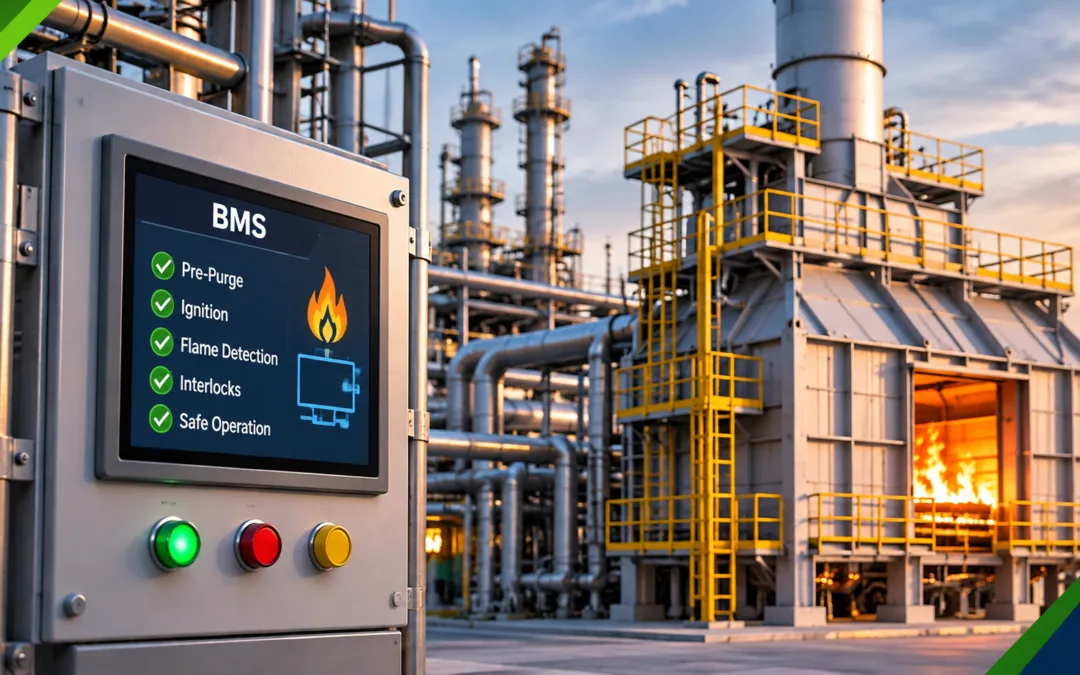
Burner Management Systems: Functions and Industrial Applications
Industrial burners are used in a wide range of process heating equipment, including fired heaters, furnaces and other combustion-based systems. Because these systems involve fuel, ignition and high-temperature operation, they require appropriate safety controls to manage operating sequences and respond to potentially unsafe conditions.
A burner management system is designed to perform these essential safety functions. It supervises the burner operating sequence, checks that required conditions are satisfied before ignition and initiates protective actions when unsafe conditions are detected.
In oil and gas, refining, petrochemical and power generation facilities, burner management systems play an important role in supporting the safe operation of combustion equipment.
What Is a Burner Management System?
A Burner Management System (BMS) is a safety-related control system designed to manage the safe start-up, operation and shutdown of industrial burners.
It uses field instruments, safety logic and final control elements to monitor operating conditions and control specific safety functions.
Depending on the burner and heater design, a BMS may monitor:
-
Fuel pressure and availability.
-
Combustion air conditions.
-
Purge sequence completion.
-
Ignition sequence.
-
Flame presence.
-
Burner operating status.
-
Safety interlocks.
-
Emergency shutdown conditions.
The exact functions depend on the equipment design, applicable standards, hazard assessment and project requirements.
A BMS is not simply a standard process control system. Its safety functions must be engineered and validated according to the applicable requirements.
Main Functions of a Burner Management System
A BMS performs several functions throughout the operating cycle of a burner.
1. Pre-Start Safety Checks
Before a burner can start, the system checks whether the required operating conditions are satisfied.
These conditions may include suitable fuel pressure, available combustion air, correct valve positions and healthy safety instrumentation.
If a required condition is not met, the system prevents the start sequence from proceeding.
2. Furnace Purging
Before ignition, the combustion chamber may need to undergo a purge sequence to remove potentially hazardous combustible gases.
The purge sequence is designed around the furnace volume, airflow, equipment configuration and applicable safety requirements.
The BMS verifies that the required purge conditions have been achieved before allowing ignition to proceed.
3. Ignition Sequence Control
The ignition sequence ensures that the burner follows the required start-up procedure.
Depending on the burner design, this may involve operating the ignition device, opening the appropriate fuel valves and confirming the presence of a stable flame within the required time.
If flame establishment is unsuccessful, the system should initiate the protective response specified by the safety design.
4. Flame Detection and Monitoring
Flame monitoring is a critical function of a burner management system.
A flame detector monitors whether the burner flame is present under the required operating conditions.
If flame failure is detected, the BMS initiates the designed safety response, which may include shutting off the fuel supply to prevent unburned fuel from accumulating.
The detection technology and response logic depend on the burner type, fuel, flame characteristics and system design.
5. Operating Interlocks
Interlocks prevent the burner from operating when specified safety conditions are not satisfied.
Examples may include:
-
Low or high fuel pressure.
-
Loss of combustion air.
-
Flame failure.
-
Equipment or fan failure.
-
Emergency shutdown signals.
-
Other project-specific safety conditions.
The interlock arrangement must be defined through the safety requirements and engineering design for the installation.
6. Controlled Shutdown
A burner management system also manages shutdown functions.
A normal shutdown follows the specified operating sequence, while a safety shutdown is initiated when a defined unsafe condition occurs.
The system response is designed to place the burner in a safe condition, including the appropriate isolation of fuel.
How Does a Burner Management System Work?
Although the exact operating sequence varies between installations, a typical burner management sequence follows several stages.
-
System readiness: The BMS verifies that the required instruments, interlocks and equipment are available.
-
Pre-purge: The combustion chamber undergoes the specified purge sequence.
-
Ignition: The ignition system operates according to the approved sequence.
-
Flame confirmation: The system confirms that the burner flame has been established.
-
Normal operation: The BMS continues monitoring the defined safety conditions.
-
Shutdown or trip: The system carries out the required shutdown response when commanded or when an unsafe condition is detected.
The BMS safety sequence should be developed and validated for the specific equipment. A generic sequence should not be copied from one installation to another without engineering review.
Burner Management System vs. Combustion Control System
A Burner Management System and a combustion control system are related, but they do not serve exactly the same purpose.
The two systems may exchange signals or be integrated within a wider control architecture, but their responsibilities must remain clearly defined.
The BMS should not be treated as a replacement for process control, nor should ordinary process control logic be assumed to provide the required burner safety functions.
Industrial Applications of Burner Management Systems
Burner management systems are used wherever industrial combustion equipment requires controlled and safeguarded operation.
1. Oil and Gas Facilities
Oil and gas facilities use fired heaters for applications such as crude oil heating, gas heating and other process duties.
A BMS helps supervise the operation of burners installed on this equipment and manages the required safety sequences.
2. Refineries
Refineries use fired heaters across different process units to provide heat to process streams.
The BMS is an important part of the overall combustion safety arrangement, helping manage burner start-up, flame monitoring and shutdown functions.
3. Petrochemical Plants
Petrochemical facilities rely on process heating equipment for various production operations.
Burner management systems are designed around the requirements of the individual heater or furnace, taking into account the operating conditions and applicable safety requirements.
4. Industrial Furnaces
Industrial furnaces use combustion systems to achieve specific heating conditions for materials and production processes.
The BMS monitors the defined safety conditions and manages the required burner operating sequences.
5. Thermal Fluid Heaters and Water Bath Heaters
Thermal fluid heaters and water bath heaters use fired burners to generate the heat required by their respective heating processes.
Their burner management systems must be designed to suit the burner configuration, fuel system, heater arrangement and project-specific safety requirements.
Standards and Safety Requirements for Burner Management Systems
The design of a BMS should be based on the applicable regulations, standards, risk assessment and project specification.
Depending on the application, relevant standards and frameworks may include:
-
IEC 61508: Functional safety of electrical, electronic and programmable electronic safety-related systems.
-
IEC 61511: Functional safety for the process industry sector.
-
NFPA standards: Relevant requirements for combustion equipment and industrial heating applications.
-
EN and other national standards: Requirements applicable to the equipment, installation and project location.
A Safety Integrity Level (SIL) requirement should be established through the appropriate hazard and risk assessment process. A BMS should not be assigned a SIL rating simply because it uses a particular controller or component.
Integraheat states that its BMS solutions are developed with reference to a range of international standards and certifications, including IEC 61508 and IEC 61511 where applicable to the specified system.
Integraheat
Why Is BMS Integration Important?
A burner management system must work correctly with the burner, fuel train, instrumentation and other relevant equipment.
Poor integration can lead to operational difficulties, unclear system responsibilities and challenges during commissioning or maintenance.
An integrated approach can help ensure that:
-
Safety functions are defined across the complete combustion system.
-
Instrumentation and final control elements are suitable for their intended functions.
-
Start-up and shutdown sequences are aligned with the burner design.
-
System interfaces are clearly documented.
-
Testing and commissioning can be carried out against defined requirements.
The BMS design should also consider future maintenance, troubleshooting and potential upgrades.
Upgrading an Existing Burner Management System
Existing combustion equipment may require a BMS upgrade when its control technology becomes obsolete, safety requirements change or operational performance needs improvement.
An upgrade may involve:
-
Evaluating the existing burner and fuel train.
-
Reviewing the current safety logic and interlocks.
-
Assessing instrumentation and flame detection.
-
Replacing or upgrading control panels.
-
Integrating the new system with existing equipment.
-
Testing and validating the revised safety functions.
The scope should be based on a detailed engineering assessment rather than replacing components without reviewing the complete system.
Choosing the Right Burner Management System
A suitable BMS must be designed around the equipment it protects.
The burner type, fuel characteristics, operating sequence, safety requirements, instrumentation and applicable standards all influence the system architecture.
Integraheat provides burner management system design, programming, integration and upgrade services for industrial combustion applications.
Explore our Burner Management Systems to learn more about our solutions, or contact our team to discuss your combustion safety requirements.